A landscape where nature, history and human memory meet
If we think about what makes Hřebečský hřbet exceptional, we only need to take a short trip through the local region. As soon as we leave the hustle and bustle of the main roads for a moment and start to notice the surroundings, a landscape full of remarkable traces of human activity opens up to us, as well as evidence of ancient geological processes. In the imprints of life in the Tertiary sea, we can glimpse the times when the local hills did not yet exist in their present form.
Recent and ancient history intertwine here in the landscape, buildings, and inconspicuous details that are easily missed at first glance.
A landscape marked by time
The events of the 20th century deeply affected the Hřebeč region. After World War II, the German-speaking population was displaced and the region was subsequently resettled by people from various parts of the country. This process caused a certain severance of ties to the landscape, which had been shaped for centuries by the coexistence of man and nature. Only with the passage of time has interest in the uniqueness of the Hřebeč region been reawakened – not only in terms of geology, but also in terms of history and nature.
Mineral wealth of Hřebče
The landscape of the Hřebečský hřbet has provided livelihoods for local residents for generations. Some raw materials, such as brown coal, served primarily local needs. However, others have transcended the region’s significance.
Thanks to the exceptional quality of the local refractory clays, the Hřebeč region has gained world renown. Mining activities have left behind not only technical monuments but also a specifically shaped landscape, which today is one of the greatest attractions of the area.
Strážný vrch Lookout Tower - Views inspired by the mining past
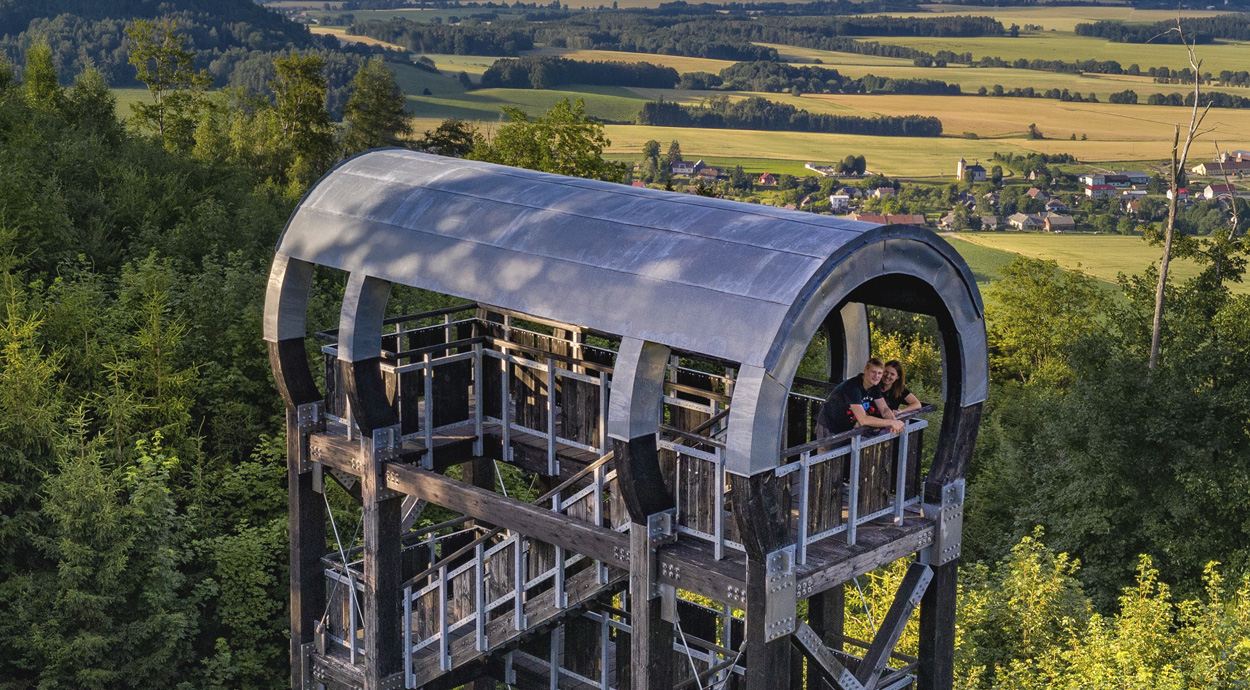
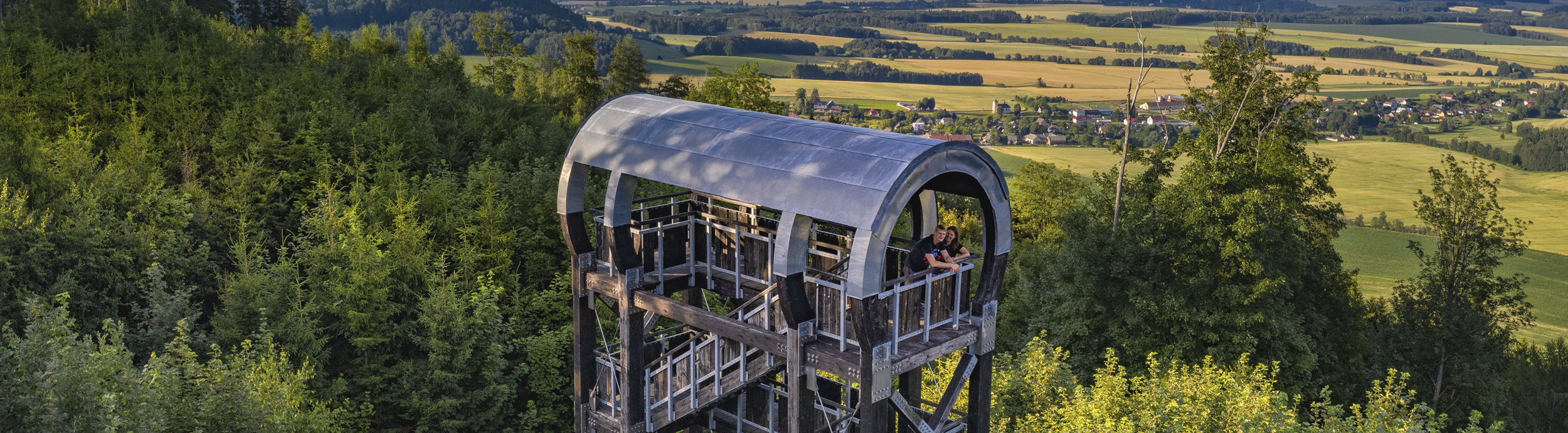
The lookout tower on Strážný vrch (590 m above sea level) resembles a mining tower in its shape, symbolically referring to the mining history of the region. 67 steps lead to the viewing platform at a height of 14 meters, and climbing them is rewarded with a beautiful view. You will have a view of Moravská Třebová, part of the Orlické Mountains and, if visibility is good, also of the Králický Sněžník massif. The lookout tower is an ideal destination for a family trip or a stop on a longer route through Hřebečské.
Viewpoint Nad doly - Landscape under your feet
The Nad doly viewing platform is located 124 steps lower than the main route. The straight staircase consists of several arms anchored into the marl rock cliff, and the journey to the viewpoint itself is an experience. The platform offers a beautiful view of the Moravskotřebovská basin. To the east you will see Moravská Třebová, to the right the road to the Hřebeč tunnel including the viaduct. To the south rises Roh (660 m above sea level), the highest peak of the Hřebečský ridge, and the horizon is closed by the strip of Zábřežská vrchovina.
In the vicinity of the viewpoint, you can see exposed, weathered rock. The alternation of day and night temperatures creates extreme conditions here, where mosses and lower plants thrive. The heated rock surfaces are also a refuge for lizards, blind snakes, vipers and spiders.
Lunar Landscape - When Nature Completes Man's Work
One of the most impressive places in the Hřebeč region is the so-called Moon Landscape. This unique scenery was created by dumps of unprocessed shale and tailings from the surrounding mines, which water and wind gradually transformed into wavy ridges and rivulets. A heap of tailings spreads out on a steep slope, the surface of which truly resembles a lunar relief. The place offers not only a beautiful view to the east of Moravská Třebová and the surrounding area, but also unique conditions for photography. Especially when the sun is low, a fascinating play of light and shadow is created here. In the area of the former Hřebeč Mines, you can also see abandoned operational buildings, which are gradually being reclaimed by nature. Educational boards provide information about the history of the place. Admission is free and the site is accessible at any time, but ideally during good visibility. The Hřebeč–Doly station can also be reached by the historic narrow-gauge railway, which is the terminus of the Mladějovská narrow-gauge railway.
Rusty Stream - An open-air natural laboratory
The rusty stream flows from a hereditary adit under the former concrete plant in Hřebč at an altitude of 470 m. It continues as the Udánecký stream and flows into the Kunčínský stream in Moravská Třebová. Its characteristic rusty color and sulfurous odor are the result of chemical reactions between water, rocks, and coal containing sulfides. This naturally produces acidic mine waters with a high iron content, which form ocher deposits.
A series of artificial cascades have been built on the stream, which help aerate the water and accelerate the oxidation of iron, thereby gradually purifying it. The Rusty Stream is not only an interesting natural phenomenon, but also an example of the connection between natural and technical processes.
Nature trails and the Hugo tree
The Hřebečské mining trails are approximately 70 km long and include 22 educational stops. Information panels introduce visitors to geology, mining, mining techniques and local nature.
“I’m Hugo the Permon and I’ll show you around Hřebečské. I know where the treasures are, where it’s said to be haunted, and where the miraculous water springs. Stick with me so you don’t get lost!”
The trails are suitable for walkers, cyclists, and families with children and strollers.
Welcome to the Hřebečský hřbet region, a region where you can move from the educational panel to the lookout tower, from the gazebo to the narrow-gauge railway, from the museum to the quiet lakes on the hilltops – and always discover something new.